
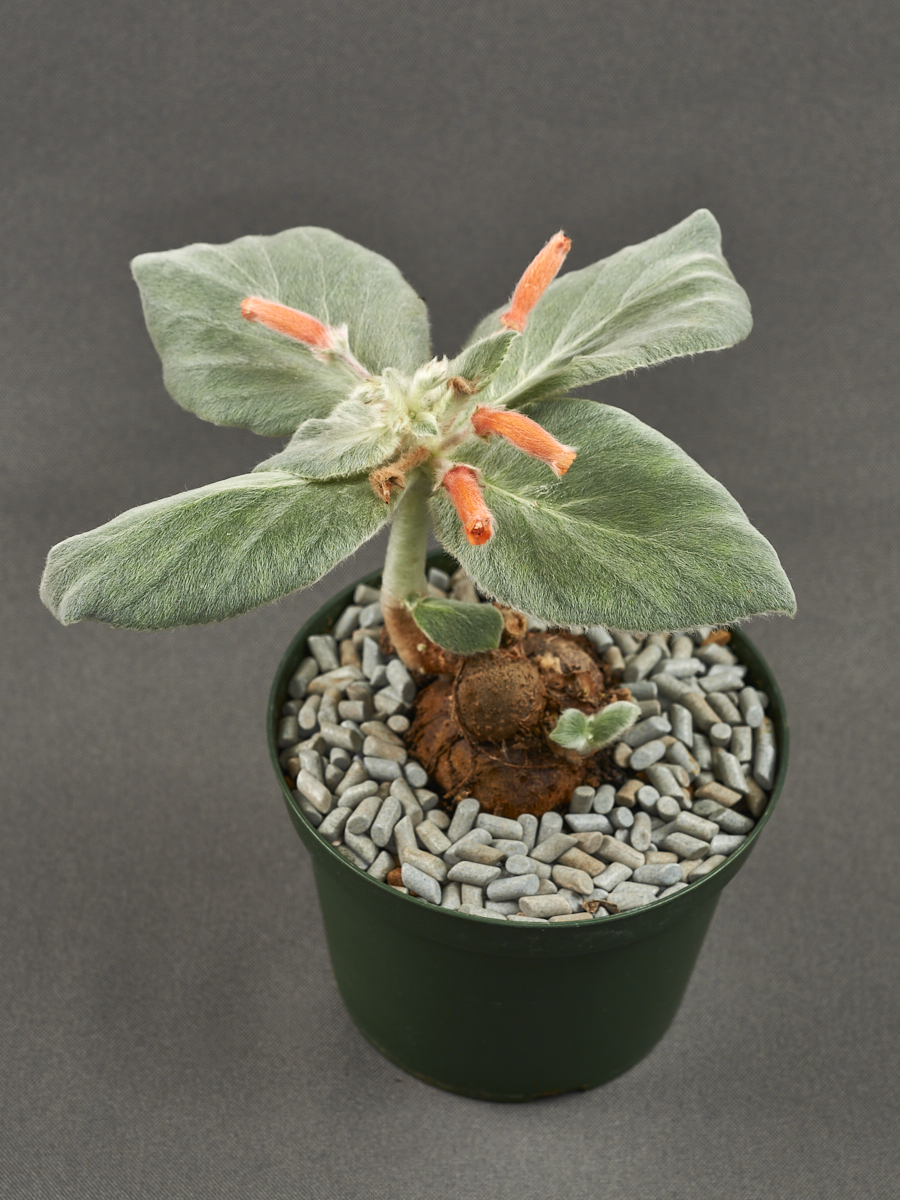
The gesneriad (pronounced either “guess-NARE-ee-ad” or “jez-NARE-ee-ad”) family contains over 3,200 species of plants. The best-known member of the gesneriad family is the African violet (Saintpaulia).
In addition to the African violet, some of the more common gesneriads grown by hobbyists are the florist gloxinia (Sinningia speciosa), lipstick plant (Aeschynanthus), goldfish plant (Nematanthus), cape primrose (Streptocarpus), flame violet (Episcia), and Cupid’s Bower (Achimenes).
The family was named for Swiss botanist Konrad Gesner (1516 – 1565).
A distinction is made between “Old World” Gesneriads (those from Asia, Africa, Europe and Australia), and those from the “New World,” (South and Central America). The former are said to belong to the sub-family Cyrtandroideae, the latter to the sub-family Gesnerioideae.
Most gesneriads are from tropical and subtropical regions and are often found growing in humus-filled depressions or rock crevices, on humus-covered forest floors or epiphytically on tree branches. Some gesneriads (known as “alpines”) are also found in colder, temperate areas, and can tolerate several degrees of frost. Gesneriads are found on all continents except Antarctica.
Many gesneriads bloom throughout the year, an especially welcome sight on a cold winter day.
This is a plant family of great diversity, and many grow under the same conditions we enjoy. Many of the easiest and most beautiful plants for the home or greenhouse belong to the gesneriad family. Some gesneriads go dormant for a short period of time. These are either tuberous or rhizomatous gesneriads.
A tuber is a starchy underground storage organ. Some gesneriads have tubers which can get quite large, up to a foot in diameter. Tuberous gesneriads are often grown with the top third of the tuber above the soil line, making for an unusual presentation. Tuberous gesneriads generally have a dormant period and resprout after a short period of time. Tuberous gesneriads are found only in South America and are considered New World gesneriads.
The tuberious gesneriads include Sinningia, Nautilocalyx and Chrysothemis.
A rhizome is a modified stem that grows underground and serves as a storage organ. Rhizomes can be smooth or scaly. The scales are modified leaves. Like tuberous gesneriads, those with rhizomes generally have a dormant period and resprout after a short period of time. Those with scaly rhizomes are found only in the New World.
Gesneriads that produce rhizomes are Achimenes, Smithiantha and Kohleria.
Gesneriads that are neither tuberous nor rhizomatous are considered to be fibrous rooted. Unlike tuberous and rhizomatous gesneriads, fibrous rooted gesneriads never go dormant. However, once the main growth dies the plant is usually lost. Fibrous rooted gesneriads are found all over the world.
There are many gesneriads that are considered fibrous rooted. Examples are Columnea, Episcia and Saintpaulia (the African violet).
Be sure to view our resources page for additional information.